Stripe Adaptive Pricing vs PPP Pricing
Stripe Adaptive Pricing converts your price at the exchange rate. PPP pricing changes the amount. What each does, what buyers pay and how to use both.
If you’ve ever tried to charge different prices by country, your search might have gone like this:
You search “Stripe regional pricing” and find an article on how Stripe can handle price conversions. Great, right? Well, what Stripe handles is Adaptive Pricing, not PPP pricing.
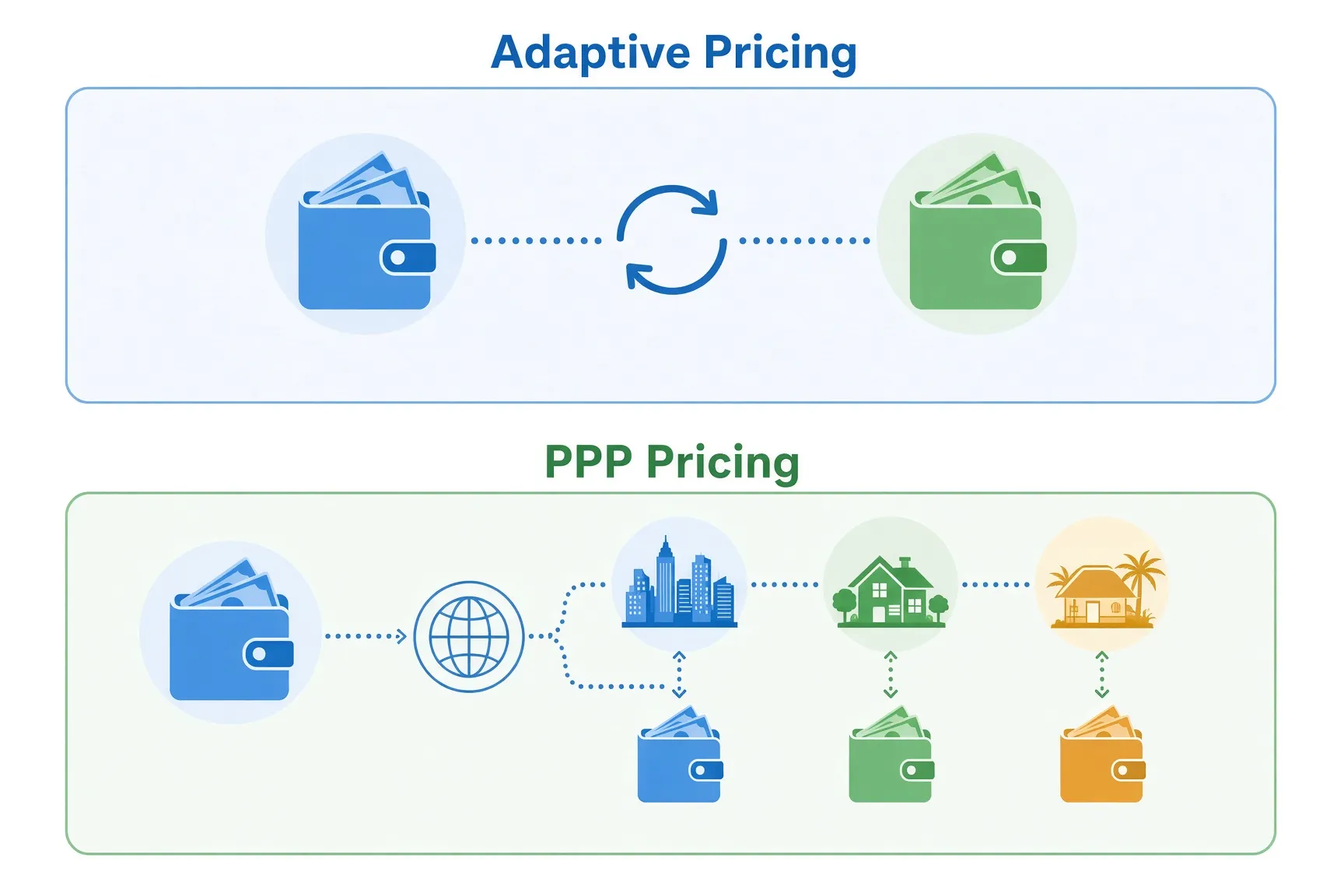
What is Adaptive Pricing? It simply converts one currency to another but keeps the value the same. So, turn it on and a buyer in India sees your $49 plan in rupees. A buyer in Brazil sees it in reais.
It looks like regional pricing. But that rupee price is still $49, plus a fee. For most people in India that is several days of income, and seeing it in rupees doesn’t make it any more affordable.
PPP pricing, on the other hand, is the better way to price your products across the world.
That’s the difference between Adaptive Pricing and purchasing power parity (PPP) pricing. One changes the currency. The other changes the amount. This post covers what each one does, what buyers actually pay, and how to use them together.
What is Stripe Adaptive Pricing?
Adaptive Pricing is a Stripe Checkout feature that shows your price in the buyer’s local currency, converted at the mid-market exchange rate plus a 2–4% fee that the buyer pays. It covers about 150 countries, and you still get paid in your own currency.
What it does well:
- A familiar currency. Buyers don’t have to guess the conversion.
- Local payment methods. Some methods only work in local currency.
- No work. It’s a setting, not code.
However, it doesn’t change what your product actually costs.
What is PPP pricing?
PPP pricing charges each country a different amount based on what money is worth there.
The World Bank publishes these price levels for nearly every country. Multiply your price by the price level and you have a starting point. Brazil is at 0.46, so a $49 plan becomes about $23.
Most products round these into four or five tiers and set a floor around 25–35% of the base price. Our Stripe PPP guide covers how to choose them.
What’s the difference between Adaptive Pricing and PPP pricing?
Adaptive Pricing changes the currency a buyer sees, while PPP pricing changes how much they pay.
| Stripe Adaptive Pricing | PPP pricing | |
|---|---|---|
| What changes | The currency | The amount |
| Based on | Exchange rates | What money is worth locally (World Bank price levels) |
| Who pays the fee | The buyer, 2–4% on top of the exchange rate | Nobody, it’s just a lower Price |
| Who it helps | Buyers who can afford your price but want their own currency | Buyers who can’t afford your price at all |
What do I choose?
PPP pricing, for most B2C or B2B businesses. It brings in more customers and more revenue, as long as each new customer doesn’t cost you much to serve.
Most of your price is margin. Discounted sales are new revenue from people who would otherwise pay $0. Buyers in the U.S. and other high-cost countries still see your full price, so you don’t give anything up there.
You don’t have to give up Adaptive Pricing to do it. Leave it on and it shows your PPP price in the buyer’s currency.
Want to see what PPP pricing would do for you?
Run your last month of Stripe payments through the free PPP calculator to see what each country would pay.
PPP CalculatorEnter your price and customers, or drop in your Stripe export, and see your revenue with PPP pricing in about a minute. Free, no sign-up.See what I could make →How to add PPP pricing to Stripe with EasyPPPRecommended
EasyPPP instantly sets up PPP pricing for you, and it works with Adaptive Pricing on or off:
- Creates a sibling Price for each tier on your existing Stripe Products, in your base currency
- Picks the right Price for each visitor, by country
- Protects against users using a VPN or proxy
Your pricing page gets the visitor’s price and Price ID from one request:
const { data: [price] } = await fetch(
  "https://api.easyppp.com/v1/price?key=ep_live_…&prices=price_1Pro",
).then((r) => r.json());<div className="rounded-2xl border p-8"> <h3>Pro</h3> <p className="text-5xl font-bold">$49</p> <p className="text-5xl font-bold">{price.display}</p> <Button>Start now</Button></div>Your U.S. price and your existing Prices stay exactly as they are. EasyPPP never edits or deletes a Price.
Let your coding agent set it up.
Paste the prompt into Claude Code, Codex or Cursor. It connects Stripe, creates your Prices and updates your pricing page, asking you before each step.
Frequently asked questions
Is Stripe Adaptive Pricing the same as PPP pricing?
No. Adaptive Pricing converts your price into the buyer's currency at the mid-market exchange rate plus a 2–4% conversion fee, so the value stays the same. PPP pricing changes the amount based on what money is worth in each country, so buyers in lower-cost countries pay less.
Who pays the Adaptive Pricing fee?
The buyer. Stripe adds a 2–4% conversion fee to the exchange rate it shows, and you receive your full price in your own currency, minus Stripe's usual processing fees. Buyers who choose to pay in your currency skip the fee, though their bank may charge its own.
Can I use Adaptive Pricing and PPP pricing at the same time?
Yes. Create a lower Price in your own currency for each PPP tier, and send the right one to Checkout. Adaptive Pricing then shows that lower amount in the buyer's currency. The PPP Price sets how much they pay and Adaptive Pricing sets which currency they see it in.
Can I do PPP pricing with Stripe's manual currency prices?
Only roughly. Manual currency prices (currency_options) let you set one amount per currency, but many currencies cover countries with very different price levels. Germany and Greece both pay in euros, and Greece's price level is about 20% lower. Countries that pay in U.S. dollars, like Ecuador and El Salvador, would get your U.S. price.
Does Adaptive Pricing increase conversion?
Stripe says it has increased international revenue by an average of 17.8%, without describing how that was measured. Showing a familiar currency and local payment methods helps. It doesn't help buyers for whom the price itself is too high, which is the problem PPP pricing solves.
Sell to 186+ more markets today.
Connect Stripe and import your prices in about five minutes.
10% of PPP revenue, nothing on your base price